


.png?width=300&name=podcast_hmwf_Frank_2%20(3).png)


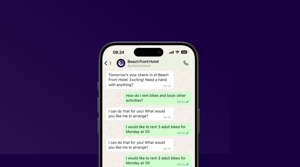
In short: How conversational AI works for hospitality businesses
|
Most hospitality businesses are short-staffed, with sector vacancies sitting at around 48% above pre-pandemic levels in the UK, and similar trends seen across other countries. Receptionist and front desk roles are among those hit hardest, yet guests increasingly expect an instant reply via messaging apps like WhatsApp, not waiting on hold for 30 minutes or a next-business-day email response. In this article, we explain how conversational AI helps to close this gap for hotels, hostels, serviced apartments, holiday parks and campsites, without guests feeling like they’re talking to a robot.
Where conversational AI fits into the guest journey
Hospitality businesses can use conversational AI to proactively reach guests on the channels they're already using—such as WhatsApp, SMS, email, and OTA inboxes—sharing useful information about their stay and timing personalized upsell offers for when guests are most likely to say yes.
It connects to the existing property management systems (PMS) so that it has the full context on every guest and their booking details. If the request is complex or the guest asks for a person, it flags the conversation for your front office team to pick up. See how it works across the guest journey in the below table.
|
Stage |
What guests need |
Conversational AI |
|---|---|---|
|
Booking confirmed |
Confirmation, travel-related questions, check-in info, |
Opens the conversation with guests by sharing useful information in the lead up to their stay, answering queries, and suggesting personalized offers |
|
Check-in |
Check-in process, key card, information about stay |
Welcomes guests and sends clear check-in instructions, either in-person or digitally |
|
Stay |
In-stay requests, book add-ons, report issues. |
Handles 90%+ of guest requests and shares in-stay offers based on their booking |
|
Checkout |
Late-checkout options, departure info |
Provides clear guidance on check-out and option to book late check-out if available. |
|
Post-checkout |
Payment questions, reviews |
Answers any post-stay queries and suggests leaving a review and/or offers loyalty offers |
Conversational AI vs chatbot for hospitality businesses
The main difference between conversational AI and basic chatbots is that conversational AI understands the sentiment behind guest questions and uses its extensive knowledge base to respond, whereas chatbots typically respond to questions using an ‘if this then that’ logic.
Conversational AI works by combining natural language processing, which figures out what a guest actually means, with a live connection to the property's own systems, so the reply is grounded in that guest's real stay information rather than a generic script. Watch the below video to see how Runnr.ai’s data infrastructure works.
It also replies in the guest's own language and matches the tone of voice you set for your property type and brand, whether that is casual, professional, or extra warm.
Common mistakes hospitality businesses make when adopting conversational AI
While conversational AI has huge potential for hospitality businesses, its impact is heavily dependent on how it is implemented. Here are some common mistakes properties make when it comes to conversational AI:
- Treating proactive messages as marketing. Sending automated upsell offers that are generic, badly timed, and too sales-y leaves a bad first impression and is ineffective in actually getting upsells confirmed.
- Skipping the tone-of-voice setup. Messages should sound like a real staff member from your property, whether sent by a human or AI, so take time to adjust the tone of voice to your unique brand.
- Mishandling the knowledge base. Conversational AI is only as good as the information and database it is working from, so make sure your data layers are properly set up and your conversational AI tool is connected to your existing systems like the PMS.
- Not introducing it to staff properly. The properties seeing the strongest results from conversational AI are the ones who introduce it as a tool that works alongside staff to give them more time for guests, not a replacement.
Getting these things right is what separates conversational AI that guests enjoy chatting with from a bad chat experience where guests don’t get the service or answers they need.
Three real properties that are improving guest experience with conversational AI
Now that we’ve looked at the mistakes that many hospitality businesses make, let’s take a look at the ones who are getting it right today by using conversational AI as part of Runnr.ai’s guest experience platform.
Hey Lou Hotels, a seven-property group in Germany with more than 1,500 beds, rolled out Runnr.ai across its entire portfolio in six weeks. The group now automates 92% of guest communication on average, with one property hitting 100% automation in individual months, and cuts response times to under an hour. This saves 200+ hours of front desk time per month at some properties.
Andreas Proempeler of Hey Lou Hotel Monheim explains:
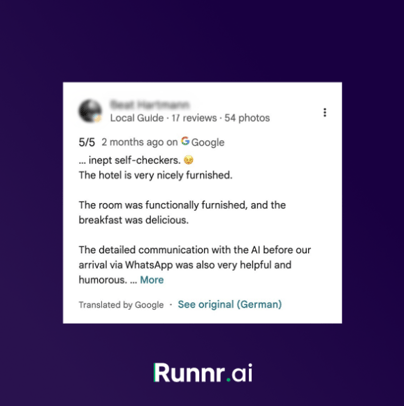
“Runnr.ai is a major gain for our hotel. Less effort for the team, more experience for the guest, that's the kind of technology that is truly making a difference in the hospitality industry.” And the proof is in the guest reviews, with guests frequently mentioning the chat in 4- and 5-star reviews.
Frenchospitality, which operates six independently owned hotels and aparthotels across France, uses Runnr.ai to ease guests through arrival and check-in, historically one of the most anxious moments of a stay. Guests get the right information at the right time through quick-reply buttons, and the system holds its own even on more complex, multi-step requests. As Mathieu Weiss of Frenchospitality describes:
“Even the more complicated requests where it needs to handle some back and forth, it's doing really a great job on that.”
Resort Valley, a holiday park in the Veluwe region of the Netherlands, uses Runnr.ai to handle communication with its guests. The park now automates 85% of guest questions, and staff report working far more easily as a team without every request needing to go through the front desk. As Inge Loeffen explains:
“In the beginning we found it quite nerve-wracking, because suddenly AI takes over your entire guest communication. But over time we've noticed that it's really completely optimized. It's now become so good that some guests don't even realise they're actually talking to an AI module.”
Getting started with conversational AI
If you are weighing up whether conversational AI fits your property, why not see it in action in a real WhatsApp conversation, or book a demo to explore how our guest experience platform could work for you.
FAQs about conversational AI
Does conversational AI replace your front desk team?
The short answer is no—but it gives staff more time with guests and helps you handle peak seasons and times without adding headcount. Conversational AI like Runnr.ai can automate 90%+ of responses to guest messages, as well as actioning requests in your PMS. This significantly reduces the admin burden for front desks and gives guests a 24/7 virtual concierge service even if the front desk is not staffed overnight.
What channels does conversational AI work on?
Conversational AI can work on any channel, depending on the solution it is part of. Runnr.ai uses conversational AI across WhatsApp, SMS, email, and OTA inboxes, with a unified inbox interface for front desk teams to access all conversations.
How long does it take to set up conversational AI?
Setting up conversational AI can take minutes, weeks, or even months if it is part of complex software implementations. The Runnr.ai setup typically takes around 45 minutes, and it is typically fully up and running alongside your team within a matter of days.